HMS Theseus Firefly Accident
“Six Men Lose Their Lives in Carrier Accident” screamed the headlines from the Argus on Monday July 21 1947. A tragic set of events during formation flying manoeuvres over Port Phillip Bay by a visiting flying squadron from HMS Theseus resulted in a horrific accident that claimed many young airmen. The planes were flying in close formation when two Fairey Fireflies crashed together and plummeted into the sea. This is now a protected site and permission must be granted by Heritage Victoria to visit.
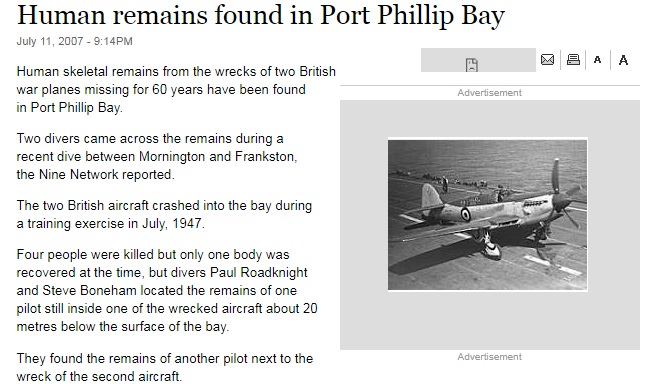
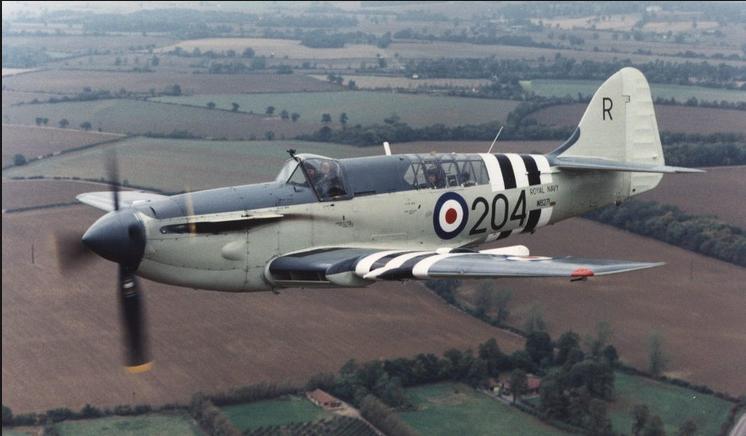
On 20/7/1947, The two Firefly planes (PP589 and TW677, both of 812 Squadron FAA RN, aboard HMS Theseus) collided mid-air and crashed at Frankston, 15 miles from Melbourne. The four occupants – two in each aircraft – died in the crash. According to a contemporary newspaper report .
“Royal Navy Squadron Has Tragic Day
PLANES COLLIDE IN AIR ON DECK: SIX KILLED
MELBOURNE, Sunday.-
Six Royal Navy men were killed and one injured with in an hour during the British Aircraft Carrier Squadron flying manoeuvres in Port Philip Bay today. Two Firefly planes from the aircraft carrier Theseus collided in midair and the four men aboard were killed.
The other deaths occurred when planes crashed on the flight deck of the Theseus and the other aircraft carrier of
the squadron, H.M.S. Glory.The flying manoeuvres had been put on as a farewell gesture to Melbourne, and thousands of people who lined the foreshore of Port Philip in brilliant sunshine saw the accidents.
The first tragedy was at 2.05 p.m., when two Firefly aircraft took off from the carrier Theseus, and in climbing away from the ship became locked together. From 1000 feet they crashed into the sea off Frankston, 15 miles from Melbourne. Their four occupants, two pilots and two navigators, were killed.
The’ escorting destroyer H.M.S. Cockade searched the area where the planes disappeared, but picked up only one body. Planes from the Theseus also searched, but could find no wreckage.
The second tragedy occurred 40 minutes later, when a Seafire – the Royal Navy’s version of the Spitfire – making an erratic landIng, slewed around, narrowly missing the ‘batsman.’ who orders the planes in and striking a seaman who was badly injured. He died later.’All the planes from the Theseus were then diverted to Point ‘Cook, where one crashed on landing, but no-one was hurt.
The third tragedy occurred, at 2.47 p.m; when a Seafire plane, piloted by Lieut.-Commander W,.N. Waller, of Aldershot — commanding officer of 805 Squadron — came in to land on the carrier H.M.S.Glory. The plane missed the arrester wires, bounced over the two crash barriers, and crashed into planes parked at the other end of the flight deck.
SAFETY DASH
FLIGHT deck mechanics dived for safety as the plane crashed, but two were injured, one seriously and one slightly hurt. The pilot was unhurt. The seriously injured man died while being rushed to Heidelberg Military Hospital. Ships’ officers said it was the first time that an aircraft had missed both arrester wires and crash barriers on landing.
Fire-fighting crews were quickly in action. Petrol flowed over the deck, but did not catch alight. It was sprayed with foam by the fire-fighting crew. The Commanding Officer of H.M.S. Glory (Captain W. T. Couchman) said later this was Glory’s first serious mishap in 15 months.
No serious damage was done to the planes into which Lleut.Commander Waller crashed. Every effort was made to get the seriously injured man speedily to hospital. The injured man was swung over H.M.S. Glory’s side by a crane and transferred by launch to H.M.S. Contest, Glory’s escorting destroyer.Contest then rushed at 40 knots— its top speed— to Station pier, Port Melbourne.
GAVE OXYGEN
THE destroyer’s propellers ‘threshed a 15ft high wave, and nearly capsized several fishing vessels as it speeded to rush the injured man ashore. Several doctors had been aboard H.M.S Glory to watch the flying exercises. One of them, Dr. F. G. Fenton, a Collins Street specialist, and brother of Dr. Fenton, the North Australian flying doctor, administered oxygen to the uncon scious man before he was taken ashore at Station Pier.An ambulance rushed the injured man to Heidelberg Military Hospital, but he was dead on arrival. Crowds on Station Pier saw the stretcher brought ashore, where in the morning the aircraft carriers had been farewelled.”