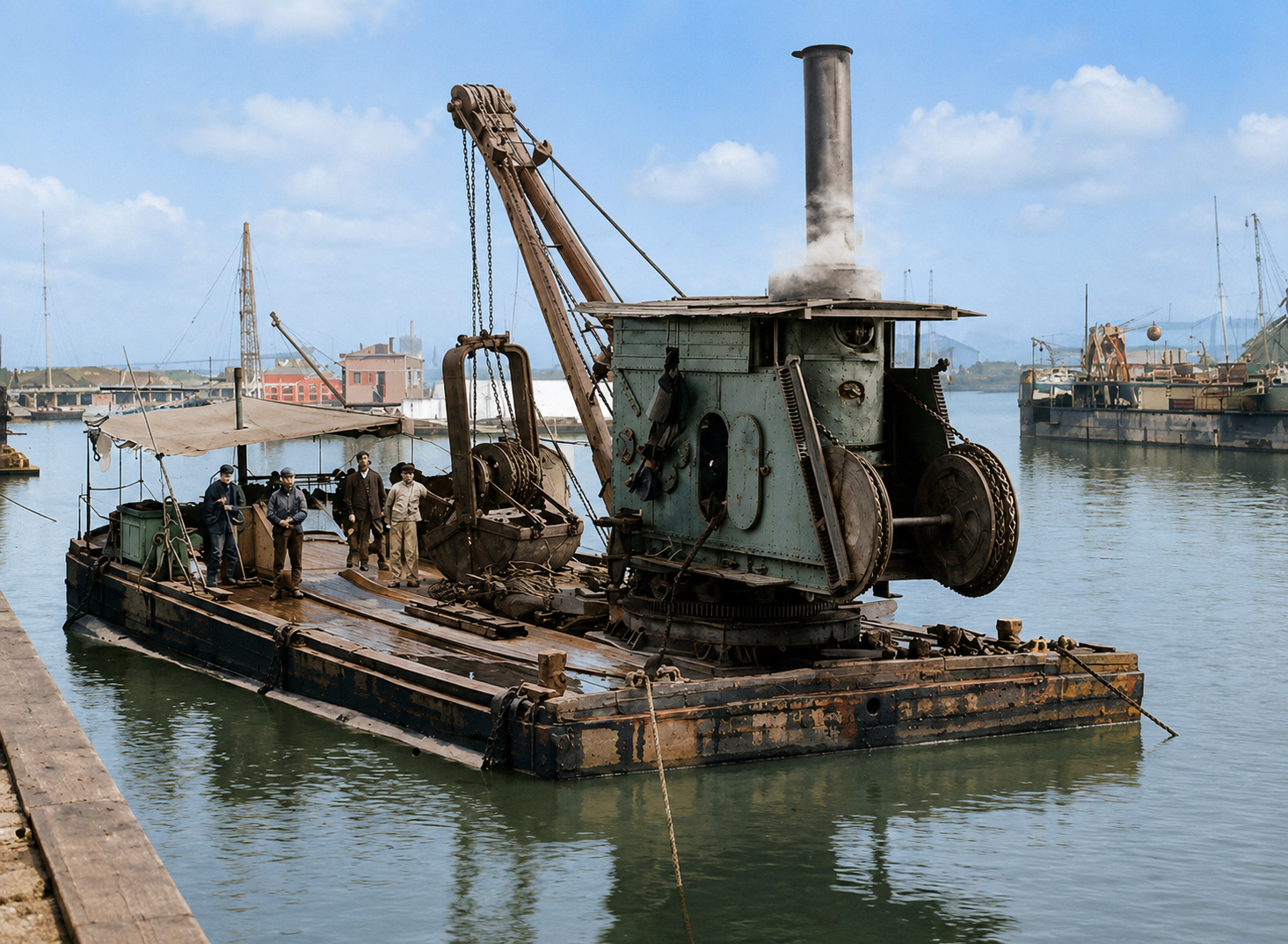
Dandenong Floating Crane
The Dandenong was found in May 2014 around the entrance to Westernport Bay by members of the MAAV Des Williams ,Peter Taylor and IANTD Instructor Mick Whitmore. The wreck was dived on slack water as the currents are quite treacherous at the entrance to Westernport. Inset on the right you can see a crane of similar construction. The discovery was a relief After many fruitless searches for this elusive wreck. Due to the strong tidal conditions at the entrance to Westernport Bay slack water is the only time access can be made easily as the currents run at about 4 knots.
This 30 metre barge was lost off McHaffie Reef in February 1913 while on the way from Melbourne to Flinders Naval Depot in ballast. naval authorities Wan ted a dredge for work at the naval base at Western port, and they bought the Dandenong for1400. All the caulking had fallen out of the seams, but this did not trouble the authorities, and one morning Dandenong was towed- down the bay and out of the Heads. No sooner had she dropped into a fair seaway than her seam opened out, and she leaked like a basket, and began to settle down. An alarmed crew stood , by the towline with an axe. and they barely had time to sever it and make their escape over the stern m a dinghy as the Dandenong gave a final plunge and sank, just inside the entrance to Westernport. She went down in 13 fathoms of water, between M’Haffie’s Reef and the beach , on Phillip Island, about half a mile from the shore. This was on February 8th 1913..The tug returned to Melbourne, having placed a buoy over the wreck, and reported the total loss to the Commonwealth, navy. The authorities determined to recover the unseaworthy craft. Some 50 men were detailed for. the work. They proceeded to the scene in the torpedo boats Countess of Hopetoun and Childers. After cruising about Western-port Harbour for three days, the buoy; marking the scene of the wreck ‘was located, and preparations were made for .beginning the salvage. Headquarters were established at Cowes, on Phillip Island, and the torpedo boat ”fussed” between that port and the wreck with a most business like appearance. A few’ fishermen and other nautical folk were very sarcastic regarding the salvage operations.
They, sneered because the torpedo boats collided with the diving boat and smashed away half her gun-wale,- rammed – the wharf in making alongside on various occasions, thereby causing damage both to naval property and the pier, ran into a buoy which. .marked a dangerous shallow, and got stuck on sandbanks while casting .off to proceed to the wreck.
Two divers acompanied the torpedoboats. One was the diving instructorto the navy, and, by reason of his superiorknowledge, he had to descend to the wreck ‘by himself on almost everyoccasion. leaving tho other man on thesurface to descend to his help should
he be in danger. The old dredge layin what is regarded as the worst spotin tho harbor, where the tide runs upto seven or eight knots, producing.’ inany sort- of a breeze, a fierce “rip” thatis described as far worse than at PortPhillip Heads. Necessarily, therefore
the work was one of difficulty and danger. The diver found – himself swept by the rapid current, and he was only able to go down for half an hour be-tween the ebb and flow tides. He succeeded in getting a wire rope round part of the wreck, and fastening the end to a buoy on the surface; but during the intervals of descent the wreck stood on end from the rush of the sea. Owing to the rush of the; current, and the hawser was washed away from the hull. This experience was several times repeated. Had two divers gone down together, it is pointed out, one to the stem of the wreck, and one to the bow, they would have been able to connect the two hawsers, and buoy them together, so that they would hold the stays. Then the lines could have been in made fast to a couple of barges at low tide ,and at high tide they would have been raised above the seabed some 15ft, and the whole concern could have been towed inshore by a powerful tug boat. Such representations were made , to headquarters, but the idea was rejected. A tug would cost too much, and another diver was not available. The authorities, however, saw no other way out of the difficulty, and the gunboat Protector, on her way from Adelaide to Hobart, was communicated with. She was ordered ‘to proceed to Westernport, and lend assistance to the work of salvage., The Protector arrived on the harbour the following week. On the following ‘day a hawser was passed round the. wreck and was made fast to the. gunboat at low tide. At high tide the wreck was taken in tow, jumping along the seabed A violent bump and the’ hawser parted. Having done so much, the gunboat continued on her ‘voyage to Hobart.
On Tuesday last the diver went be-low again to examine the wreck. When he reached the surface again he was in-tensely, amused. He had found that Protector had pulled the ancient dredge to piece. The three weeks’ salvaging had cost more than the rotten Old vessel was worth, and ended all hope of raising her. However, the sailors had been having a most enjoyable time and were loathe to leave the scene. There was yet hope that the anchors and cables might be recovered, and so the two torpedo boats remained in the harbour, and the diver went down again every day, except when the weather was inclement. They torpedo-boats are still engaged in the salvaging But this break in naval routine has not been absolutely barren of good results. All the men aboard the torpedo boat declare that they have put on weight since it commenced. Holiday-makers, too, have derived great amusement from it. They enjoy trips to the wreck, and take snapshots of the diversin their picturesque costumes.
The two’ torpedo-boats have been down at Phillip Island, for nearly a month,,-and the cost per day of running these tiny craft, including coal, provisions’ and salaries, amounts to in excess 25 each. In addition, the cost of towing down the two barges was 80,and four enormous beams of oregon, to assist salvage operations, cost 100. Incidental. expenses will run in-to another 100. Altogether, it is estimated the salvage will have cost the Naval department about 2000.This added to the cost of the ancient dredge, in the first instance, brings the total up to 34oo. The critics of our naval administration down at Westernport experienced., nautical men some of them declare that the affair is nothing short of- shameful; They declare that the dredge would have in all probability have been safely raised and beached in four days by the aid of a powerful tugboat , three divers ,and a couple of men, with a knowledgeof salvage work.
– See more at: http://www.phillip-island-balcony.com/Phillip-Island-shipwrecks.html#sthash.aNmGDarD.dpuf